BPMN template: Leave request
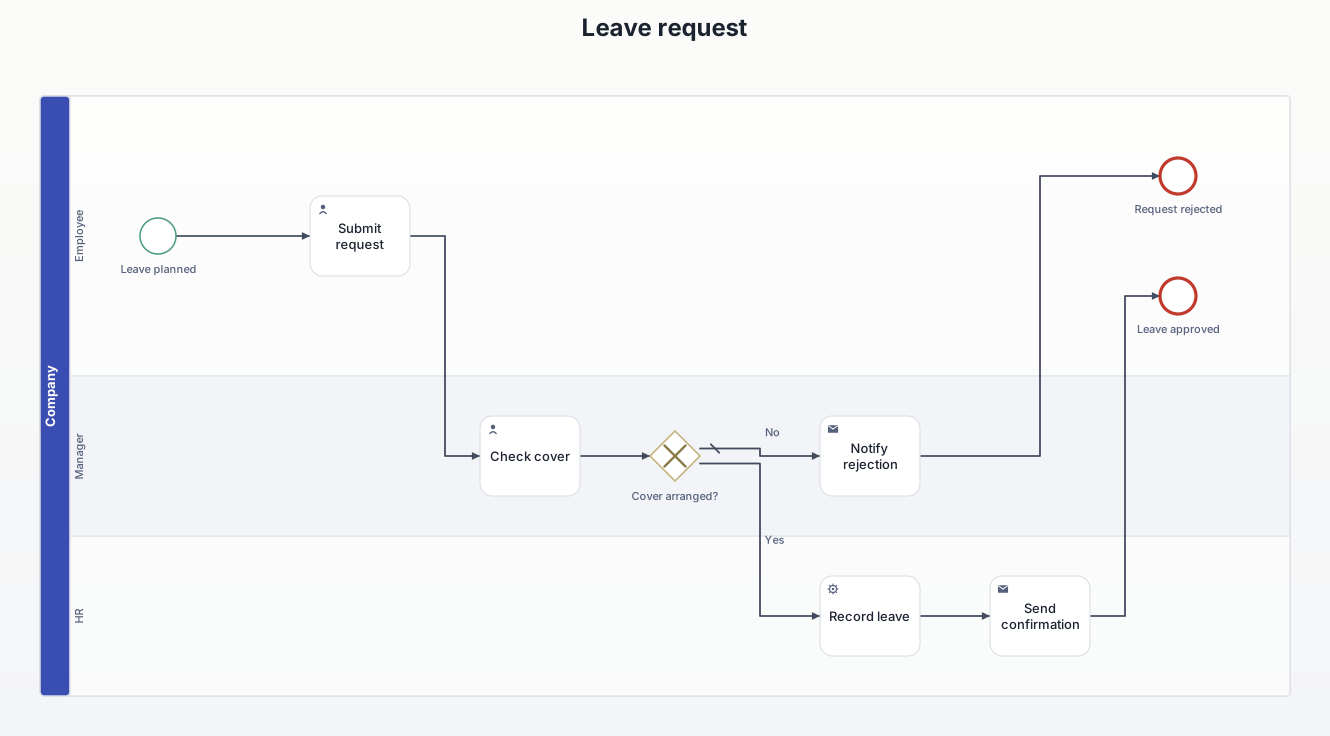
An employee requests leave, the manager checks cover and team planning, HR records it. A classic first BPMN example.
What this diagram is for
Good for learning: three roles, one decision, two outcomes. In practice it shows where requests get stuck.
Roles (lanes and pools)
- Employee: submits the request.
- Manager: checks cover and decides.
- HR: records the leave and confirms.
Decisions and events
- Cover arranged? Without cover the request is rejected and the employee gets a reason.
All elements
| Element | Type | Role | Next |
|---|---|---|---|
| Leave planned | Start event | Employee | → Submit request |
| Submit request | User task | Employee | → Check cover |
| Check cover | User task | Manager | → Cover arranged? |
| Cover arranged? | Exclusive gateway | Manager | → Record leave [Yes] → Notify rejection [No] |
| Notify rejection | Send task | Manager | → Request rejected |
| Request rejected | End event | Employee | – |
| Record leave | Service task | HR | → Send confirmation |
| Send confirmation | Send task | HR | → Leave approved |
| Leave approved | End event | Employee | – |
Rebuild it in AIxFlow
Free: tap the start event, add the 9 elements one after another with +, add the roles as lanes, then tap “Arrange automatically” – AIxFlow does the rest.
Faster with Pro: describe the process in your own words or take a photo of a sketch, and the AI builds the diagram. Exporting a BPMN 2.0 file (for Camunda, bpmn.io, Signavio) is Pro as well.
BPMN modeling on iPad and Mac. Free for up to three diagrams.
Can I download the templates as .bpmn files?
No, this page is view-only. Rebuilding them in AIxFlow is free; exporting a .bpmn file is part of Pro.